The pharmaceutical industry is changing rapidly with the adoption of digital technologies, automation, and advanced computer-based systems. From drug manufacturing and quality control to laboratory operations and regulatory documentation, companies increasingly depend on software and computerized systems to maintain product quality, data accuracy, and regulatory compliance. However, implementing new technology is not enough. These systems must also be reliable, secure, and suitable for their intended use.
This is where Computerized System Validation (CSV) becomes important.
CSV has emerged as a valuable career option for pharmacy graduates, life science professionals, engineers, IT professionals, and quality assurance specialists who want to build a career in the pharmaceutical industry. As pharmaceutical companies continue to invest in digital transformation and data integrity, the demand for professionals who understand computerized system validation and regulatory requirements remains an important consideration for employers.
But what makes CSV an attractive career? Why can experienced CSV professionals earn competitive salaries? And what skills do you need to enter this field?
Let us explore the opportunities, responsibilities, salary factors, and career growth associated with Computerized System Validation in the pharmaceutical industry.
1. What Is Computerized System Validation (CSV)?
Computerized System Validation is a documented process used to demonstrate that a computerized system is suitable for its intended use and consistently meets defined requirements. In regulated industries such as pharmaceuticals, biotechnology, and medical devices, computerized systems may directly or indirectly affect product quality, patient safety, data integrity, and regulatory compliance.
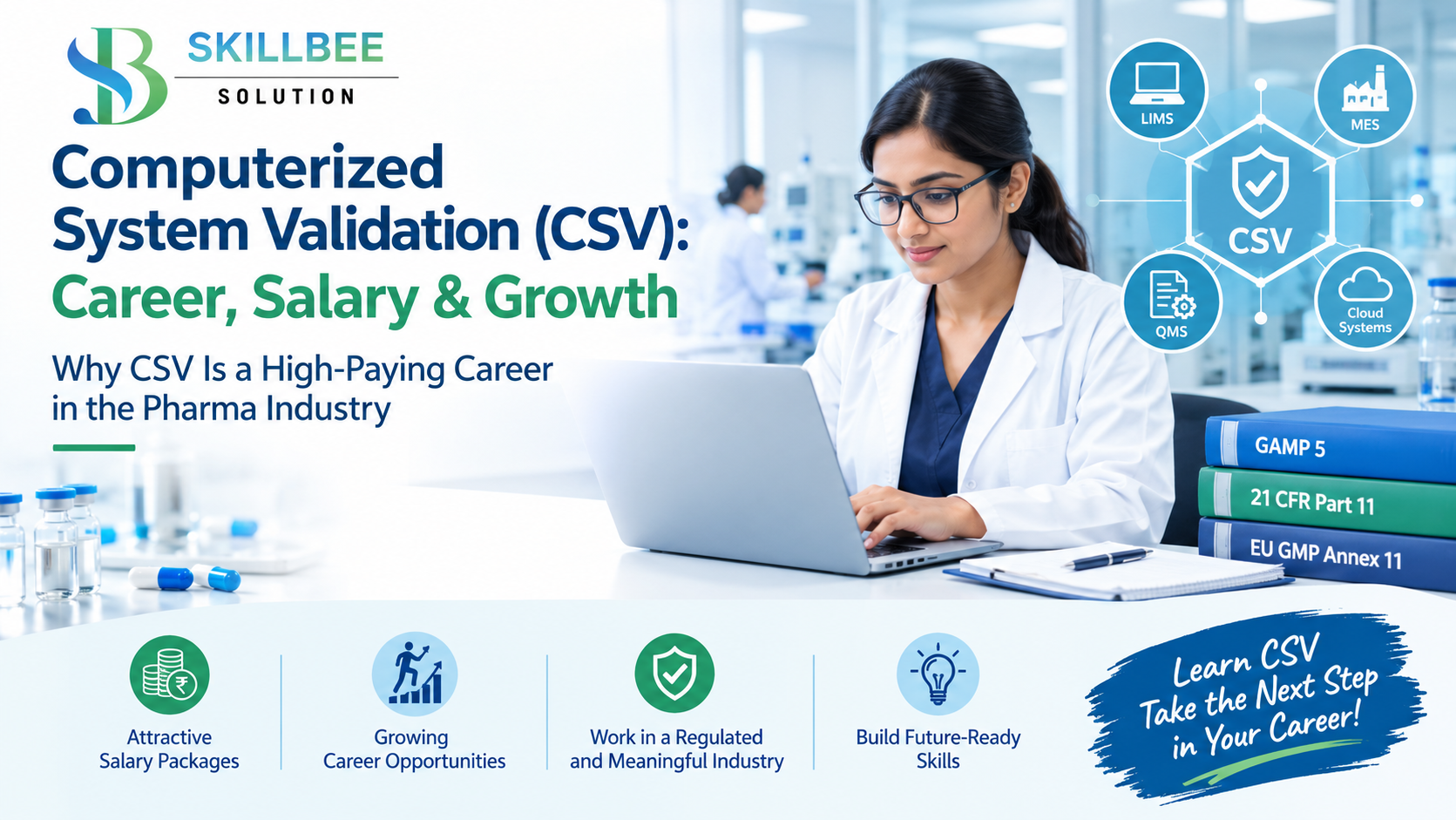
For example, pharmaceutical companies use Laboratory Information Management Systems (LIMS) to manage laboratory data, Manufacturing Execution Systems (MES) to monitor manufacturing activities, and Quality Management Systems (QMS) to manage deviations, change controls, CAPA, and other quality processes.
If these systems do not function as intended, the consequences can be serious. Incorrect records, missing data, unauthorized changes, or system failures can affect product quality and create compliance risks.
CSV helps organizations establish documented evidence that systems perform according to approved requirements. Depending on the system and its risk, validation activities may include requirement specifications, risk assessments, supplier assessments, testing, deviation management, traceability, and preparation of validation reports.
CSV professionals also work with applicable regulatory expectations and industry guidance, including FDA requirements, 21 CFR Part 11 where applicable, EU GMP Annex 11, and GAMP 5 guidance.
In simple terms, CSV helps pharmaceutical companies establish confidence that their computerized systems are fit for their intended use and operate in a controlled, compliant manner.
2. Why Is CSV Becoming an Important Career in the Pharma Industry?
The pharmaceutical industry is becoming increasingly digital. Many activities that were previously managed through paper records are now performed using electronic systems, automated equipment, and integrated software applications.
This transformation creates a need for professionals who understand both technology and pharmaceutical compliance.
Increasing Use of Digital Systems
Pharmaceutical manufacturers use computerized systems across manufacturing, quality assurance, quality control, warehousing, regulatory affairs, and laboratory operations. As organizations implement or upgrade these systems, they need qualified professionals to assess risks, define requirements, execute testing, and maintain appropriate documentation.
Greater Focus on Data Integrity
Data integrity is a critical concern in regulated pharmaceutical environments. Records must be reliable, accurate, complete, and protected against unauthorized changes or loss.
CSV professionals help verify that systems have appropriate controls, such as user access management, audit trails, electronic records controls, and backup and recovery arrangements, where applicable.
Regulatory Compliance Requirements
Pharmaceutical companies must demonstrate that their processes and supporting systems meet applicable regulatory expectations. During inspections and audits, organizations may need to provide evidence of system suitability, testing, documentation, and ongoing control.
This makes CSV an important part of the overall quality and compliance framework.
Digital Transformation in Pharma
The adoption of cloud-based applications, electronic batch records, automated laboratories, integrated manufacturing platforms, and data analytics continues to create new validation challenges.
As a result, professionals who combine validation knowledge with an understanding of modern technologies can be valuable to pharmaceutical companies, consulting firms, and technology service providers.
3. Why Can Computerized System Validation Be a High-Paying Career?
CSV can offer competitive earning potential, particularly for professionals who develop strong technical knowledge, regulatory understanding, and practical project experience. However, salaries are not automatically high simply because someone completes a CSV course. Compensation depends on skills, experience, responsibilities, employer requirements, and the complexity of the systems being validated.
Several factors help explain why experienced CSV professionals can command attractive salaries.
A Combination of Technical and Regulatory Skills
CSV professionals need to understand how software works, how business processes operate, and how regulatory requirements apply to computerized systems.
For example, a validation engineer working on a LIMS implementation may need to understand laboratory workflows, user requirements, data integrity controls, test execution, defect management, and traceability.
This combination of skills is more specialized than general documentation work alone.
Responsibility for Compliance and Quality
Validation activities contribute to the control of risks that may affect product quality, patient safety, and regulatory compliance. Errors in validation planning, testing, or documentation can create significant problems for an organization.
Professionals who can identify risks, resolve technical issues, prepare inspection-ready documentation, and coordinate effectively with quality and IT teams can become important contributors to business operations.
Experience with Multiple Computerized Systems
Professionals who have worked with systems such as LIMS, MES, QMS, ERP, electronic document management systems, and laboratory or manufacturing applications may have access to a wider range of opportunities.
The value of this experience depends on the depth of knowledge, system complexity, and ability to apply validation principles in real projects.
Specialized Consulting Opportunities
CSV professionals may work directly for pharmaceutical companies, biotechnology organizations, medical device manufacturers, IT service providers, or consulting firms.
Consulting projects can involve system implementation, remediation, periodic review, upgrades, risk assessment, and regulatory compliance support. Professionals who can independently manage such activities may qualify for senior or specialist positions.
4. What Is the Salary of a CSV Professional in India?
Salary is one of the major reasons professionals explore Computerized System Validation as a career option. However, there is no single salary range that applies to every CSV professional. Pay varies by city, company, industry segment, technical expertise, and the scope of responsibilities.
The following figures are illustrative market-oriented estimates for India, not verified current salary averages or guaranteed offers. Actual compensation can fall outside these ranges.
| Experience level | Indicative annual salary |
|---|---|
| Fresher or entry-level professional | ₹2.5–4.5 lakh |
| 1–3 years of experience | ₹4–7 lakh |
| 3–5 years of experience | ₹6–10 lakh |
| 5–8 years of experience | ₹9–15 lakh |
| 8+ years of experience | ₹12–20 lakh or more |
These ranges should be treated as broad guidance rather than a promise of earnings. Senior consultants, validation leads, project managers, and specialists with substantial experience in complex systems may earn more, while entry-level salaries can be lower depending on the employer and location.
A professional with experience in risk-based validation, GAMP 5, 21 CFR Part 11, EU GMP Annex 11, test management, and system implementation may be better positioned for certain roles than someone whose experience is limited to preparing basic documents.
It is also important to distinguish between completing a training course and gaining professional experience. Training can help develop foundational knowledge, but practical project exposure, problem-solving ability, and interview performance are important factors in securing a suitable position.
5. Career Opportunities After Learning CSV
One of the advantages of learning CSV is that the skills can be applied across different departments and computerized systems. Professionals can begin in entry-level validation roles and gradually move toward technical, compliance, or management positions.
CSV Engineer or Validation Executive
This is a common starting point for professionals entering the field. Responsibilities may include preparing validation documents, reviewing requirements, executing test cases, recording test results, managing discrepancies, and maintaining traceability.
CSV Specialist or Validation Consultant
With experience, professionals may take responsibility for validation planning, risk assessments, supplier documentation reviews, test strategy, deviation assessment, and coordination with business and technical teams.
Senior CSV Engineer or Validation Lead
Senior professionals may lead validation activities for specific systems or projects. They may review deliverables, allocate tasks, coordinate stakeholders, resolve complex validation issues, and ensure that project documentation follows approved procedures.
CSV Manager or Quality Compliance Manager
Management roles typically require substantial experience in validation, quality systems, project delivery, and stakeholder management. Responsibilities can include resource planning, project oversight, inspection readiness, governance, and review of validation strategies.
Computer Software Assurance (CSA) Professional
Computer Software Assurance is an approach associated particularly with FDA-regulated medical device manufacturing. It emphasizes risk-based assurance of software used in production and quality management systems.
Professionals who understand the principles of CSA, its appropriate regulatory context, and its relationship with established validation practices can broaden their career options.
Other potential directions include IT Quality Assurance, infrastructure qualification, laboratory systems validation, MES validation, ERP validation, data integrity consulting, and quality systems implementation.
6. Essential Skills Required to Build a Successful CSV Career
A successful CSV professional needs more than theoretical knowledge. Employers look for candidates who can apply validation principles to real situations and communicate effectively with different teams.
Regulatory knowledge: Understand the relevant requirements and guidance, including applicable FDA regulations, 21 CFR Part 11, EU GMP Annex 11, and GAMP 5.
Documentation skills: Learn how to prepare and review documents such as User Requirements Specifications (URS), Functional Requirements Specifications (FRS), risk assessments, test scripts, traceability matrices, and validation summary reports.
Risk-based thinking: Understand how to assess system functionality, identify potential failures, evaluate their impact, and determine appropriate testing and controls.
Testing and defect management: Develop practical knowledge of test planning, test execution, expected versus actual results, deviation handling, defect tracking, and retesting.
Data integrity: Understand audit trails, access controls, electronic records, electronic signatures where applicable, backup and recovery, and other controls relevant to the system.
Communication and teamwork: CSV projects involve QA, IT, system owners, vendors, engineering, laboratory teams, and business users. Clear communication is essential for resolving issues and keeping projects on track.
Tools and system knowledge: Familiarity with systems such as LIMS, MES, QMS, ERP, and electronic document management platforms can be helpful. Experience with project and test management tools such as Jira, Xray, or similar applications can also be an advantage.
The most valuable professionals combine these skills with sound judgment and an understanding of how computerized systems support actual pharmaceutical processes.
7. Is CSV a Good Career Option for Freshers?
Yes, CSV can be a career option for freshers, although entry-level opportunities and employer expectations vary.
Candidates with backgrounds in pharmacy, biotechnology, life sciences, chemistry, engineering, computer science, information technology, and related disciplines may find the field worth exploring. The suitability of a candidate depends on the particular role and the employer’s educational and technical requirements.
Freshers should begin by understanding pharmaceutical quality systems, the basics of computerized systems, validation lifecycle activities, risk assessment, documentation, and data integrity.
They should also learn how to prepare and interpret common validation documents rather than memorizing definitions alone. Practicing with sample URS documents, risk assessments, test cases, traceability matrices, and deviation scenarios can improve confidence during interviews.
A structured CSV training program can help candidates understand the workflow of a validation project and become familiar with common industry terminology. However, candidates should be realistic: training does not guarantee employment, and some positions require prior industry experience.
For working professionals in QA, QC, IT, engineering, or laboratory operations, CSV may provide an opportunity to build on existing knowledge and move into a more specialized role.
8. How Does Practical CSV Training Help You Get Job-Ready?
Many candidates understand CSV concepts in theory but struggle when interviewers ask them to explain how they would handle a real validation activity.
For example, an interviewer may ask how to identify critical requirements, assess the risk of a software function, document a failed test, or determine whether a system change requires additional testing.
Practical training can help bridge this gap when it includes realistic exercises and constructive feedback.
A useful CSV training program should cover the validation lifecycle, GAMP 5 principles, risk assessment, applicable regulatory expectations, requirements documentation, test case preparation, traceability, deviation management, and validation reporting.
It should also explain the differences between validation activities for different types of systems and how a risk-based approach influences the level of testing and documentation.
Candidates can benefit from simulated project exercises, sample deliverables, case studies, and mock interviews. These activities help them understand how documentation connects with system functionality and quality risks.
Before enrolling, review the course syllabus, trainer’s industry experience, practical exercises, feedback process, and the support offered for interview preparation. A course that focuses only on theoretical presentations may not provide the same level of practical preparation.
9. What Is the Future of Computerized System Validation?
The future of CSV is closely connected to the continuing digitalization of the pharmaceutical and life sciences industries.
Organizations are adopting more integrated platforms, cloud-based applications, automation, electronic records, and data-driven processes. These technologies can improve efficiency, but they also introduce questions about data integrity, access management, system interfaces, cybersecurity, supplier oversight, and ongoing system control.
Artificial intelligence is another developing area. As AI-enabled applications enter regulated workflows, organizations will need to consider intended use, risk, data quality, system performance, governance, and appropriate oversight. The specific assurance or validation approach will depend on the technology, its intended use, and the applicable regulatory framework.
The industry is also placing greater emphasis on risk-based approaches. Rather than treating every software function identically, professionals need to understand which functions matter most to product quality, patient safety, and data integrity and apply suitable controls.
This means the long-term value of a CSV professional will increasingly depend on the ability to think critically, understand business processes, assess risks, and work confidently with technical and quality teams.
Professionals who continue learning and adapt to changing technologies may be better positioned for long-term career growth.
Conclusion: Is Computerized System Validation Worth Learning?
Computerized System Validation offers a promising career path for people interested in pharmaceutical quality, compliance, IT, and regulated computerized systems. Its combination of technical knowledge, documentation, risk assessment, and regulatory understanding makes it a specialized field with opportunities across pharmaceutical manufacturing, laboratories, biotechnology, medical devices, and consulting.
The potential to earn a competitive salary is an important attraction, but long-term success depends on more than salary expectations. Practical skills, professional experience, regulatory awareness, communication, and the ability to handle real project challenges all play a role in career progression.
Whether you are a fresher planning your first career move or an experienced professional looking to specialize, learning CSV can be a worthwhile step toward exploring opportunities in the pharmaceutical industry.
Start building your Computerized System Validation knowledge with SkillBee.
SkillBee offers professional training designed to help learners understand important CSV concepts, industry practices, and validation documentation. Explore the course curriculum, develop practical knowledge, and prepare yourself to pursue relevant opportunities in the pharmaceutical and life sciences sectors.
Visit https://skillbee.co.in/apply-here/ to explore available training programs and take the next step toward your career goals.
Your Success is Our Mission!