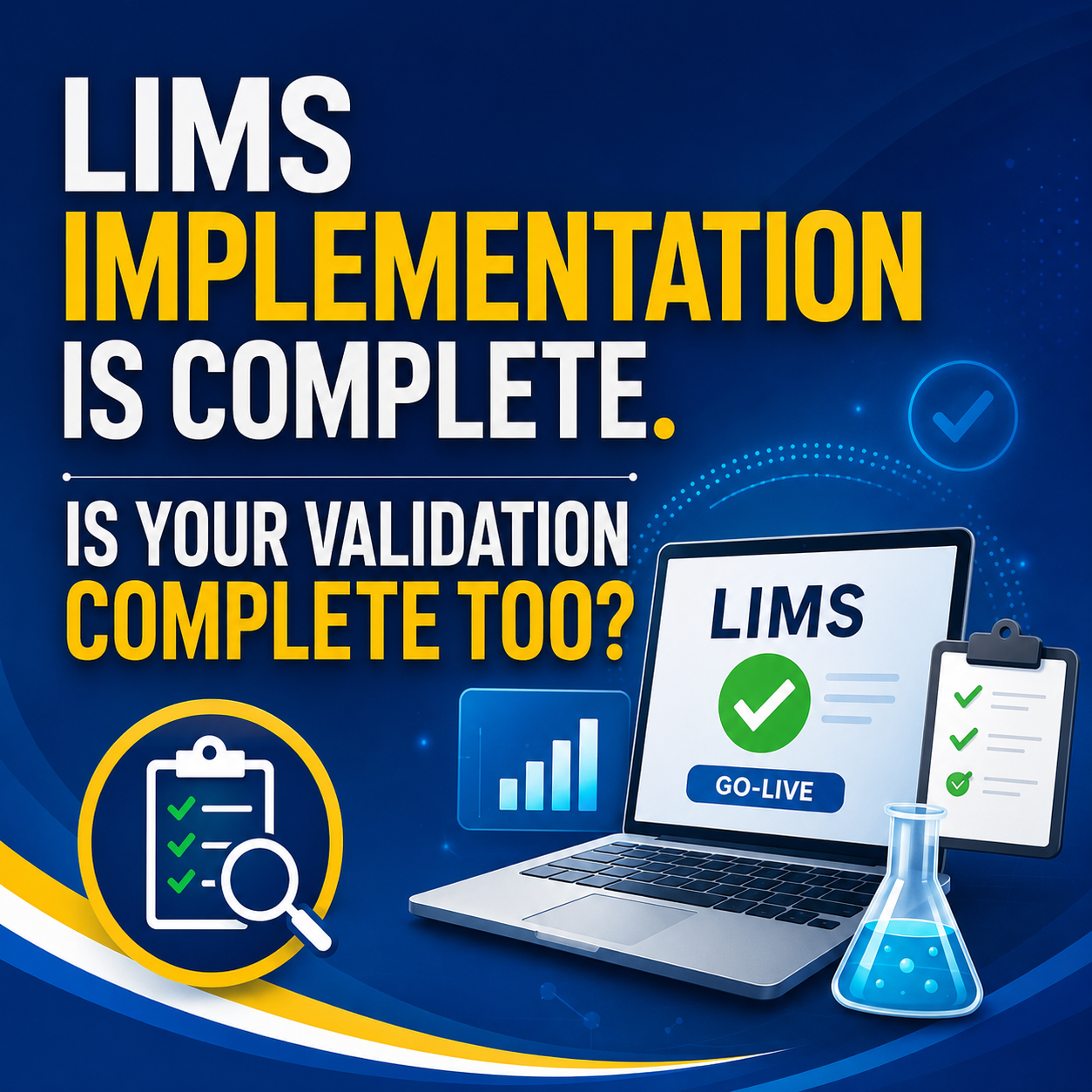
The LIMS has gone live.
The screens are working.
Users have been trained.
Samples are moving through the system.
Reports are being generated.
Everyone takes a breath.
The implementation project is finally over.
But is it?
For a pharmaceutical laboratory, getting a LIMS into production is only one part of the journey. The bigger question is whether the system has been properly validated for the way your organization actually uses it.
That difference is easy to miss.
A LIMS can be working perfectly and still have validation gaps
Let’s take a simple situation.
A laboratory implements a new LIMS. During testing, the team verifies sample registration, result entry and report generation.
Everything passes.
A few months later, the laboratory adds a new instrument and connects it to the LIMS.
The connection works.
The analysts are happy.
But was the interface assessed?
Was the change evaluated for its impact on the validated state?
Was the new data flow tested?
Were the relevant documents updated?
This is where LIMS validation becomes a lifecycle activity rather than a one-time project.
The go-live date isn’t the finish line
One of the common misunderstandings around LIMS projects is that validation ends when the system goes live.
In reality, the system will continue to change.
New users will be added.
Roles may change.
Workflows may be modified.
Instruments may be connected.
Configurations may be updated.
Software versions may change.
Data may eventually be migrated.
Every significant change raises the same basic question:
Does this change affect the validated state of the system?
That question should become part of the normal way the laboratory manages its LIMS.
Look at what actually changed
A LIMS may be validated for its intended use at implementation.
But the system running six months later may not be exactly the same system.
Maybe a calculation was changed.
Maybe a new specification was added.
Maybe a new interface was introduced.
Maybe an administrator changed a configuration.
None of these automatically means the system is no longer compliant.
But they should not simply be ignored either.
A risk-based impact assessment can help determine what needs to be reviewed, tested or revalidated.
This is where a practical CSV approach makes a difference.
Here’s something worth checking
Open your current LIMS documentation.
Now compare it with the system that your laboratory is actually using today.
Ask:
Does the documented workflow still match the real workflow?
Are the current interfaces covered?
Are user roles and permissions properly controlled?
Are important changes documented?
Can you trace critical activities through the audit trail?
Is your validation evidence still relevant?
If several answers are unclear, you may have a validation gap even though the LIMS itself is working perfectly.
The data deserves the same attention
A LIMS is not just another business application.
It may contain laboratory results, sample information, calculations, approvals and other records that support quality decisions.
That makes data integrity an important part of the validation strategy.
The question isn’t simply whether the result is stored.
Can you show where it came from?
Can you identify who performed the activity?
Can you see relevant changes?
Can the record be retrieved when needed?
Can your team demonstrate that appropriate controls were in place when the data was generated?
These are the questions that become important when an auditor starts looking beyond the software screens.
So, what should happen after implementation?
Don’t wait for an audit to discover the gaps.
A post-implementation review can be a useful starting point.
Look at the current system configuration, changes made since go-live, user access, interfaces, audit trails, procedures and existing validation evidence.
Then assess what has changed and what needs attention.
Sometimes the answer may be simple.
Sometimes additional testing or revalidation may be appropriate.
The important thing is that the decision is documented, justified and based on the actual risk.
This is where SkillBee Solution can help
At SkillBee Solution, we support pharmaceutical companies with LIMS validation throughout the system lifecycle—not only before go-live.
Our services include:
LIMS Validation | Computer System Validation (CSV) | Risk Assessment | Data Integrity Assessment | Validation Testing | Change Control | Revalidation | Audit Readiness
Whether your LIMS is being implemented for the first time or has already been running for several years, our team can help identify gaps between the validated system and the system being used today.
SkillBee Solution works with pharmaceutical organizations in Bengaluru, Hyderabad and other locations, providing practical validation and compliance support.
One question before you close this article:
If an auditor asked tomorrow, “Show me how you know your LIMS is still validated,” could your team answer confidently?
If the answer is “We validated it when we implemented it,” that may be the first thing worth reviewing.
Because going live means the system has started its real life—not that validation has ended.
SkillBee Solution
 +91 81036-35949
 info@skillbee.co.in
 https://skillbee.co.in/
LIMS Validation | CSV Services | Data Integrity | GxP Compliance | Cloud Validation