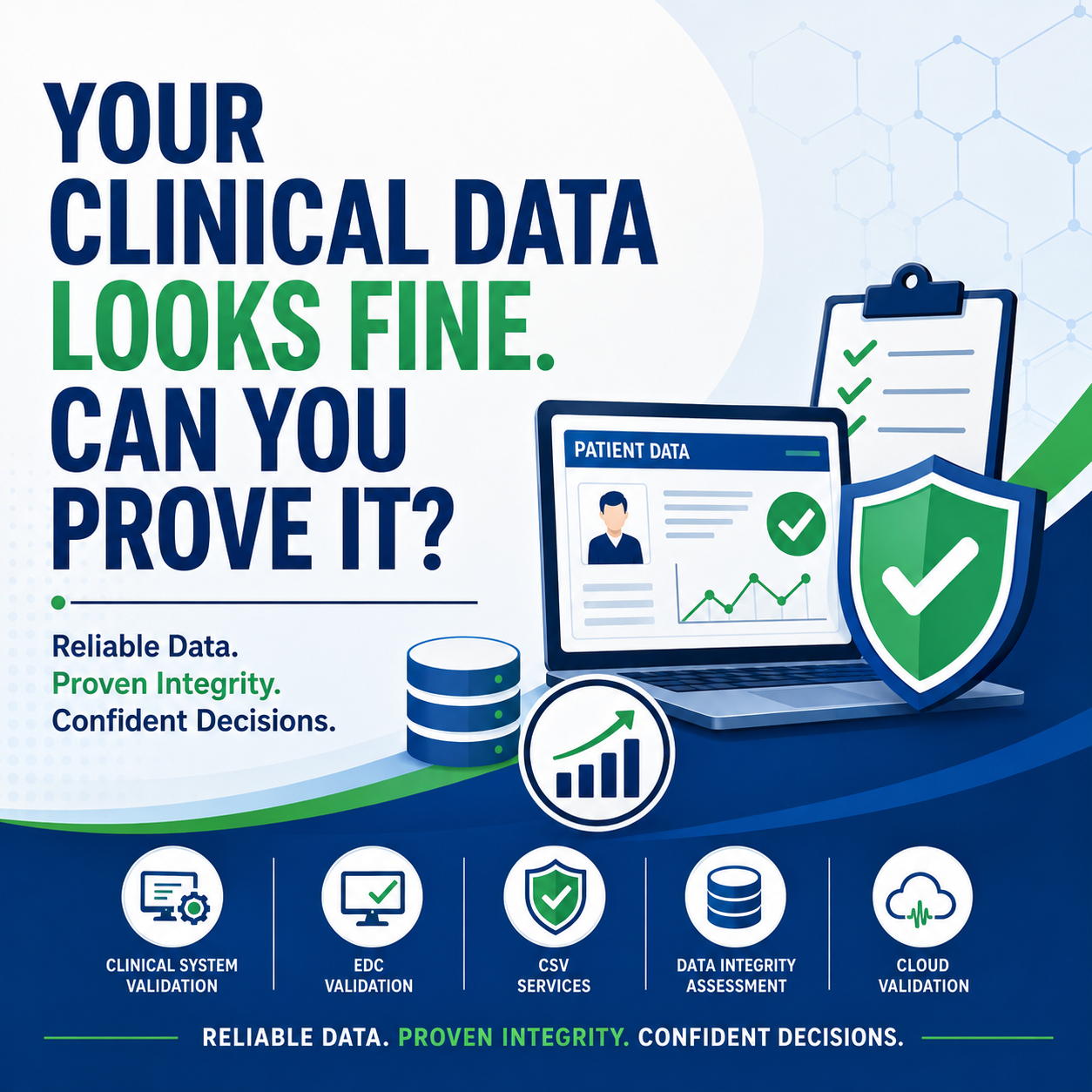
Clinical data can look perfectly normal on a computer screen.
The values are there. The records are complete. The study team can open the system and find what they need.
So, at first glance, everything seems fine.
But during an audit or regulatory inspection, someone may ask a very simple question:
“How do you know this data is reliable?”
That question can be harder to answer than it sounds.
Because having clinical data is one thing. Being able to show where it came from, who handled it, what changed, and why it changed is another.
Think about one patient record
Let’s say a clinical site enters a laboratory result into an Electronic Data Capture (EDC) system.
Later, the value is corrected.
There may be nothing wrong with the correction. The first value could simply have been entered incorrectly.
But now someone reviewing the record wants to know:
Who made the change?
When was it changed?
What was the original value?
Why was the correction made?
Was it reviewed?
If your system can clearly show this history, you have something important: traceability.
If the team has to search through emails, spreadsheets or different systems to explain what happened, that’s when concern can start.
Clinical data doesn’t stay in one place
This is something that is easy to forget.
Data may start at a clinical trial site and then move through several systems and teams.
For example:
Clinical Site → EDC → Data Review → Reconciliation → Analysis → Regulatory Submission
There can be different applications, users and interfaces involved along the way.
A problem at any point can affect the reliability of the information.
It could be an incorrect user permission.
It could be a configuration change.
It could be an interface that was not properly tested.
It could even be a system upgrade that changed something nobody expected.
The final data may still look correct.
But can you explain how it got there?
That’s the part that matters.
Where Computer System Validation comes in
This is why Computer System Validation (CSV) has an important role in clinical operations.
CSV is not just about checking whether software works.
A clinical system can open perfectly, save records and generate reports while still having weaknesses in its controls.
Validation looks at the system in the context of its intended use.
Depending on the system, this can include:
Requirements → Risk Assessment → Testing → User Access → Audit Trail → Data Integrity → Change Control
The exact approach depends on the system and the risks involved.
An EDC system, clinical database, laboratory application and safety system may all need different considerations.
The important thing is that validation should reflect how the system is actually being used.
What happens after the system goes live?
This is where things can get interesting.
A clinical system may be properly validated when it is implemented.
Six months later, something changes.
A new version is installed.
A new interface is added.
A workflow is modified.
A user role is changed.
The application moves to a cloud environment.
From an IT point of view, these may look like normal changes.
From a validation point of view, another question needs to be asked:
“What does this change affect?”
A proper change control and impact assessment helps the team decide whether additional testing, documentation or revalidation is required.
Ignoring the change is usually not the best option.
Try this before your next audit
Take one important clinical record from an old study.
Don’t just check the final value.
Try to follow its history.
Can your team show who entered it?
Can you see relevant changes?
Can you explain those changes?
Can you show that the system had appropriate controls at that time?
And most importantly, can you produce the evidence without spending half a day looking for it?
If yes, that’s a good sign.
If several people have different answers, it may be time to take a closer look at your clinical system validation and data integrity controls.
Data integrity is everyone’s responsibility
It is tempting to treat data integrity as an IT issue.
It isn’t.
Clinical operations, QA, data management, system owners and IT may all have responsibilities depending on the system and process.
The technology needs proper controls.
Users need appropriate access.
Changes need to be assessed.
Procedures need to match the way the system is actually being used.
And the supporting evidence needs to be available when required.
When these things are working together, answering an auditor’s question becomes much easier.
Need support with your clinical systems?
SkillBee Solution provides validation and compliance support to pharmaceutical and life sciences organisations.
Our services include Clinical System Validation, EDC Validation, Computer System Validation (CSV), Risk Assessment, Data Integrity Assessment, Validation Testing, Change Control, Cloud Validation and Audit Readiness.
We support organisations in Bengaluru, Hyderabad and other locations, helping them assess and maintain their regulated computerized systems throughout their lifecycle.
The objective is simple.
Not to create documents just because a project requires them.
Not to test software just to complete a checklist.
But to make sure that when someone asks:
“Can you prove that this clinical data can be trusted?”
your team has a clear answer—and the evidence to back it up.
SkillBee Solution
Clinical System Validation | EDC Validation | CSV Services | Data Integrity | GxP Compliance | Cloud Validation
 81036-35949
 info@skillbee.co.in
 skillbee.co.in
Practical validation and compliance support for pharmaceutical and life sciences organisations.