Introduction
Starting a career in regulatory affairs can be an exciting opportunity for pharmacy, life sciences, biotechnology, microbiology, and chemistry graduates. Regulatory affairs professionals play an important role in the pharmaceutical and healthcare industry by helping companies ensure that their products meet regulatory, safety, quality, and compliance requirements before and after they reach the market.
But for a fresher, there is one major challenge: How do you create a regulatory affairs resume when you don’t have much professional experience?
The good news is that you don’t need years of experience to create a strong resume. What you need is a resume that clearly communicates your education, regulatory knowledge, technical skills, internships, academic projects, certifications, and willingness to learn.
Your resume is often the first interaction a recruiter has with you. Before you get an interview, your resume needs to convince the recruiter that you have the right foundation for an entry-level regulatory affairs position.
The regulatory affairs job market can be competitive. Pharmaceutical companies, biotechnology organizations, contract research organizations (CROs), and regulatory consulting firms may receive hundreds of applications for entry-level positions. A generic resume can easily get overlooked, even when the candidate has the right educational qualifications.
This is why creating a job-ready regulatory affairs resume for freshers is so important.
A good resume should be:
- Clear and easy to read
- Professionally structured
- Relevant to the regulatory affairs job
- Optimized with industry-specific keywords
- ATS-friendly
- Focused on your strongest qualifications
- Honest about your knowledge and experience
In this guide, we will explain how freshers can build an effective regulatory affairs resume step by step—from choosing the right format to presenting education, skills, internships, certifications, projects, and career objectives.
Understanding Regulatory Affairs Before Building Your Resume
Before writing your resume, it helps to understand what regulatory affairs actually involves.
Regulatory affairs is a specialized function within the pharmaceutical, biotechnology, medical device, and healthcare industries. Regulatory professionals help organizations understand and comply with applicable regulations throughout the product lifecycle.
Depending on the organization and role, regulatory affairs professionals may work on areas such as:
- Regulatory submissions
- Product registration
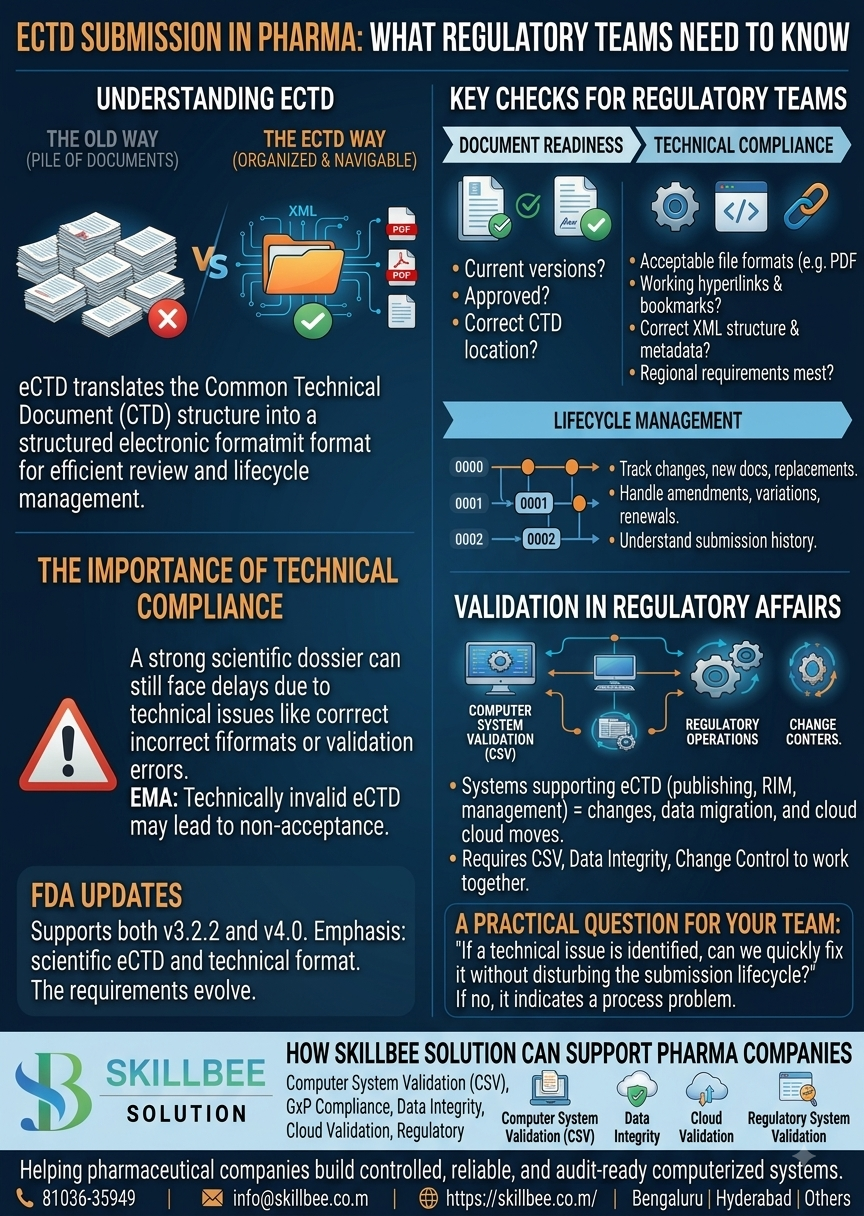
- CTD and eCTD documentation
- Regulatory documentation
- Regulatory intelligence
- Product approvals
- Compliance activities
- Labeling requirements
- Post-marketing activities
- Regulatory inspections and audits
- Communication with regulatory authorities
Regulatory professionals may interact with or work according to requirements established by regulatory bodies and organizations such as FDA, EMA, CDSCO, ICH, and WHO.
For a fresher, you may not be expected to independently handle complex submissions from day one. However, recruiters want to see that you understand the basics and have the ability to learn and work carefully with regulated documentation.
That’s why your resume should communicate two things:
“I understand the fundamentals of regulatory affairs.”
and
“I am prepared to learn and contribute in a professional regulatory environment.”
This is much more effective than simply writing “Looking for a challenging opportunity” in your resume objective.
Choose the Right Regulatory Affairs Resume Format
The first step in creating a strong regulatory affairs resume is choosing a clean and professional format.
For most freshers, a simple reverse-chronological resume format works well. Your most recent education, internship, certification, or experience should be easy for recruiters to find.
Avoid overly designed resumes with excessive graphics, multiple colors, complicated tables, or decorative elements. Regulatory affairs is a documentation-focused profession, so your resume should reflect clarity, organization, and attention to detail.
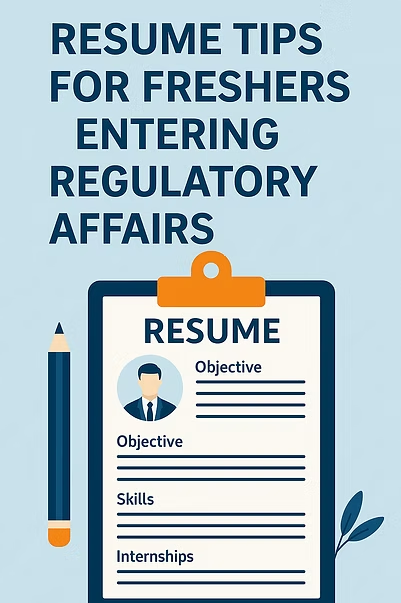
A simple structure can include:
- Contact Information
- Career Objective or Professional Summary
- Education
- Regulatory Affairs Skills
- Internship or Experience
- Academic Projects
- Certifications and Training
- Additional Activities or Achievements
Keep your resume ATS-friendly
Many organizations use Applicant Tracking Systems (ATS) to screen resumes before recruiters review them.
To make your resume more ATS-friendly:
- Use standard section headings
- Use simple formatting
- Avoid unnecessary graphics
- Use relevant keywords from the job description
- Use readable fonts
- Keep the content concise
- Avoid putting important information inside images
For most freshers, a one-page regulatory affairs resume is usually sufficient if it communicates the most relevant information clearly.
Write a Strong Regulatory Affairs Career Objective or Summary
The objective or professional summary is one of the first sections recruiters notice.
Avoid generic statements such as:
“Seeking a challenging position in a reputed organization where I can utilize my skills and grow professionally.”
Almost every fresher uses some variation of this sentence.
Instead, make your objective specific to regulatory affairs.
For example:
“Motivated B.Pharm graduate with a strong interest in pharmaceutical regulatory affairs and knowledge of global regulatory frameworks, CTD documentation, and compliance requirements. Seeking an entry-level regulatory affairs position where I can apply my academic knowledge, documentation skills, and attention to detail while developing practical industry expertise.”
This type of summary immediately tells the recruiter:
- Your educational background
- Your area of interest
- Your relevant knowledge
- The type of job you want
- What you can potentially contribute
What should a fresher include in the summary?
Try to mention:
- Degree or academic background
- Regulatory affairs specialization or interest
- Relevant training or certification
- Regulatory knowledge
- Documentation skills
- Career objective
Keep it short. Your summary should create interest—not tell your entire career story.
Highlight Your Educational Background
For a fresher, education is one of the strongest sections of the resume.
Employers looking for entry-level regulatory affairs candidates commonly consider educational backgrounds such as:
- B.Pharm
- M.Pharm
- Pharm.D
- Biotechnology
- Microbiology
- Chemistry
- Life Sciences
- Related pharmaceutical or healthcare disciplines
However, simply writing your degree and university may not fully demonstrate your interest in regulatory affairs.
Where relevant, highlight coursework, academic projects, dissertations, or subjects connected to regulatory affairs.
For example:
Relevant Areas of Study:
- Pharmaceutical Regulatory Affairs
- Quality Assurance
- Pharmaceutical Law
- Drug Development
- Pharmacovigilance
- Clinical Research
- GMP
- Regulatory Compliance
If you completed a Regulatory Affairs certification, diploma, workshop, or specialized training, make sure it is clearly visible.
This can be particularly valuable for freshers because it demonstrates that you have taken additional steps to understand the industry beyond your regular academic curriculum.
Add Relevant Academic Projects
Don’t underestimate your academic projects.
A fresher may not have professional regulatory affairs experience, but an academic project can demonstrate subject knowledge, research ability, documentation skills, and genuine interest in the field.
For example, a project related to:
- Drug approval processes
- Regulatory requirements
- FDA vs. EMA requirements
- CDSCO regulations
- CTD/eCTD
- Clinical trial regulations
- Pharmaceutical compliance
- Quality systems
can be highly relevant.
Instead of simply writing:
Project: Regulatory Affairs
provide a little more context.
For example:
Academic Project – Comparison of Regulatory Approval Processes
- Studied regulatory approval requirements across selected global markets.
- Reviewed the role of regulatory agencies in pharmaceutical product approval.
- Researched key regulatory documentation and submission requirements.
- Compared major regulatory considerations across different regions.
This gives recruiters a better understanding of what you actually learned.
Showcase the Right Regulatory Affairs Skills
Skills are an important part of a regulatory affairs resume for freshers, but simply creating a long list of keywords isn’t enough.
Instead of writing:
Skills:
Communication, teamwork, leadership, hard-working, punctual, analytical thinking.
Try to combine technical and professional skills relevant to the job.
Technical Regulatory Affairs Skills
Depending on your actual knowledge, relevant skills may include:
- Regulatory Affairs Fundamentals
- CTD/eCTD Fundamentals
- Regulatory Documentation
- ICH Guidelines
- FDA Regulatory Framework
- EMA Regulatory Framework
- CDSCO Regulatory Requirements
- Regulatory Submission Basics
- Drug Registration Process
- Regulatory Intelligence
- GMP Fundamentals
- Pharmaceutical Documentation
- Microsoft Excel
- Microsoft Word
- Document Management
Do not claim expertise in an area you have only studied briefly. Use terms such as “basic knowledge,” “familiarity,” or “working knowledge” when appropriate.
Soft Skills
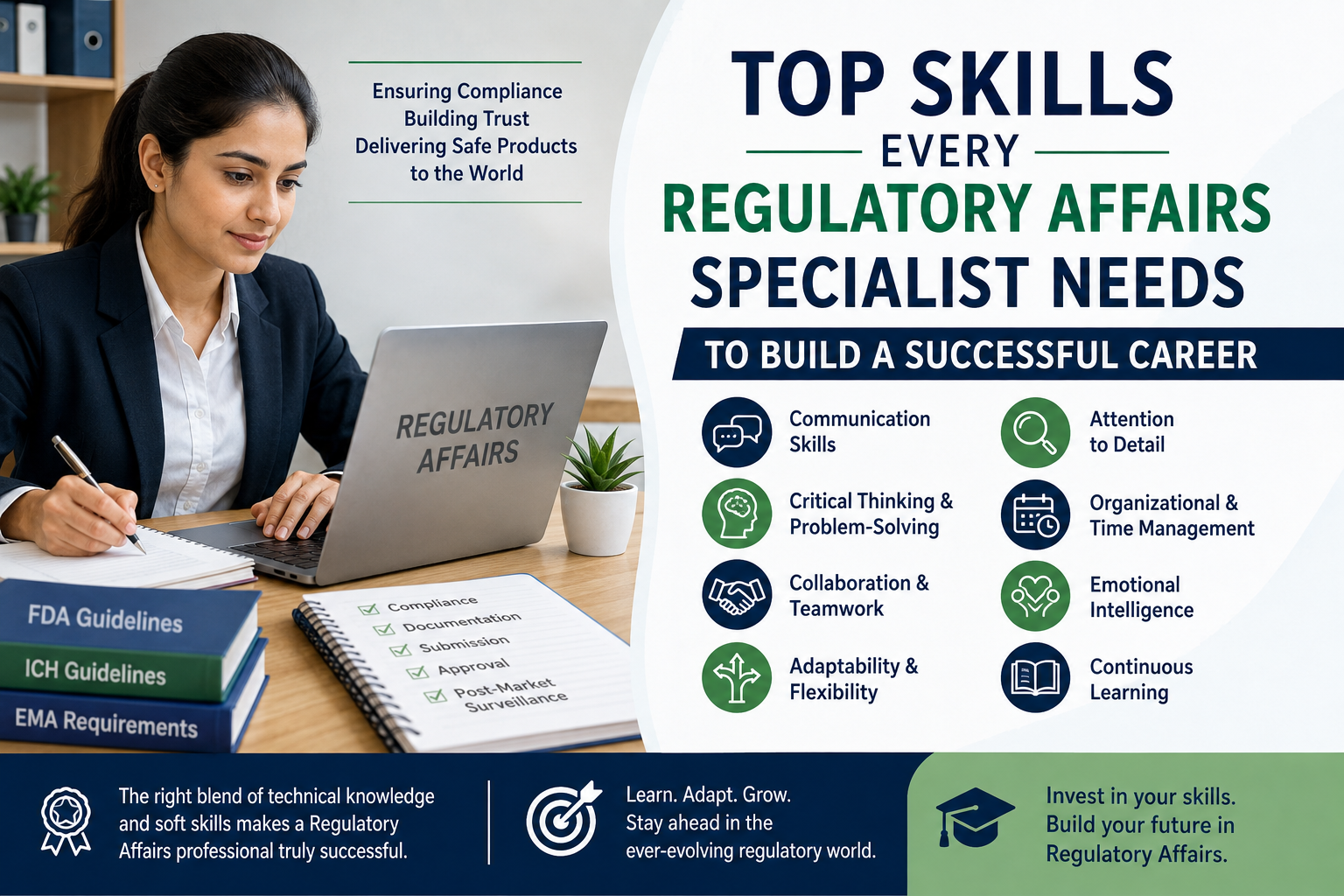
Regulatory affairs requires accuracy and effective communication, so soft skills also matter.
Useful skills include:
- Attention to Detail
- Written Communication
- Verbal Communication
- Analytical Thinking
- Problem Solving
- Time Management
- Documentation
- Team Collaboration
- Organization
- Research Skills
The best way to demonstrate these skills is through your experience and projects.
For example, instead of simply writing:
Attention to Detail
you could write:
“Reviewed academic regulatory documents for formatting consistency and completeness.”
That provides evidence of how you applied the skill.
How to Include Internship Experience as a Fresher
If you have completed an internship, make it one of the most prominent sections of your resume.
Your internship does not necessarily need to be a full-time regulatory affairs internship to be valuable.
You can highlight experiences involving:
- Regulatory documentation
- Research
- Pharmaceutical documentation
- Quality assurance
- GMP
- Dossier preparation
- Regulatory guidelines
- Audit documentation
- Data management
- Clinical research
- Pharmacovigilance
Describe your responsibilities using action-oriented bullet points.
For example:
- Assisted with the preparation and organization of regulatory documentation.
- Researched selected ICH and regulatory guidelines.
- Supported document review and formatting activities.
- Assisted in maintaining project-related records.
- Participated in discussions related to regulatory submission requirements.
Most importantly, be honest.
Never exaggerate your internship responsibilities simply to make your resume look more impressive. Recruiters may ask detailed questions during interviews.
A simple, truthful statement about what you actually learned is far more valuable than an exaggerated claim.
Don’t Ignore Transferable Experience
What if you don’t have a regulatory affairs internship?
Don’t worry.
You can still demonstrate useful professional skills through other experiences.
For example, part-time work, volunteering, academic activities, student organizations, or other internships may demonstrate:
- Communication
- Teamwork
- Time management
- Organization
- Customer interaction
- Problem-solving
- Documentation
- Responsibility
- Ability to work under deadlines
The key is to connect the experience with skills relevant to the position.
For example, a customer service role may not be directly related to regulatory affairs, but it can demonstrate communication, problem-solving, and professional interaction.
Add Regulatory Affairs Certifications and Training
One of the best ways for freshers to strengthen their profile is through relevant training.
A degree gives you an academic foundation, but additional training can demonstrate your commitment to building industry-specific knowledge.
Relevant areas may include:
- Drug Regulatory Affairs
- Regulatory Submissions
- CTD/eCTD
- Pharmacovigilance
- Clinical Research
- GMP
- Medical Writing
- Quality Assurance
- Pharmaceutical Regulations
When adding a certification, don’t simply write the course title.
Include:
- Course name
- Training provider
- Completion status/date
- Relevant subjects covered
For example:
Certificate in Drug Regulatory Affairs
Training Provider | Completed 2026
Key Areas Covered: Regulatory frameworks, CTD/eCTD, submission processes, regulatory documentation, and compliance fundamentals.
This gives recruiters more context about what you actually learned.
Continuous Learning Can Strengthen Your Profile
Regulatory requirements continue to evolve, so professionals in this field need to keep learning.
As a fresher, showing that you are actively learning can make your resume more attractive.
You can mention:
- Regulatory webinars
- Industry workshops
- Online courses
- Conferences
- Professional development programs
- Regulatory publications you follow
- Academic presentations
- Relevant professional memberships
The objective isn’t to collect dozens of certificates.
Instead, focus on quality and relevance.
Five unrelated certificates are unlikely to help as much as one or two well-chosen courses directly related to regulatory affairs.
Customize Your Resume for Every Regulatory Affairs Job
This is one of the most important resume tips for freshers.
Don’t send exactly the same resume to every company.
Read the job description carefully and identify the keywords the employer uses.
For example, a job description may mention:
- Regulatory submissions
- CTD
- eCTD
- Regulatory documentation
- FDA
- CDSCO
- ICH guidelines
- Product registration
- Compliance
- Regulatory intelligence
If you genuinely have knowledge of these areas, make sure your resume reflects them naturally.
Example
If the job description says:
“Knowledge of regulatory documentation and CTD submissions preferred.”
Your resume could include:
“Basic knowledge of CTD structure and pharmaceutical regulatory documentation developed through specialized regulatory affairs training.”
This is much more effective than submitting a generic resume.
Why does customization matter?
Recruiters want candidates who are relevant to the specific position.
A customized resume shows that:
- You read the job description
- You understand the role
- Your skills match the requirement
- You are genuinely interested in the position
Make Your Resume ATS-Friendly With the Right Keywords
If you’re searching for regulatory affairs jobs for freshers, understanding ATS optimization can give your resume an additional advantage.
Applicant Tracking Systems may scan resumes for keywords related to the job description.
Relevant keywords for regulatory affairs roles may include:
Regulatory Affairs, Regulatory Submissions, CTD, eCTD, ICH Guidelines, FDA, EMA, CDSCO, Regulatory Documentation, Drug Registration, Pharmaceutical Regulations, Compliance, GMP, Regulatory Intelligence, Product Registration, Dossier Preparation, Quality Assurance, Pharmacovigilance.
However, don’t simply add every keyword you can find.
Keywords should be used naturally and should accurately represent your knowledge.
Keyword stuffing can make your resume difficult to read and may create problems during interviews if you cannot explain the terms you’ve included.
Common Regulatory Affairs Resume Mistakes to Avoid
Even candidates with good qualifications can lose opportunities because of simple resume mistakes.
1. Using a generic career objective
Avoid vague statements that could apply to any job.
Make your objective specific to regulatory affairs.
2. Creating an overly designed resume
A regulatory affairs resume should look professional and easy to scan.
Avoid excessive graphics, colors, icons, and decorative elements.
3. Writing long paragraphs
Recruiters typically scan resumes quickly.
Use concise bullet points instead of large blocks of text.
4. Adding irrelevant information
You don’t need to mention every activity you’ve participated in.
Prioritize information that supports your regulatory affairs career goal.
5. Claiming skills you don’t actually have
Never claim advanced expertise simply because you watched a webinar or completed a short course.
Be accurate about your level of knowledge.
6. Ignoring spelling and grammar
This is particularly important in regulatory affairs.
The profession requires accuracy and careful documentation. A resume filled with spelling or grammatical mistakes can create the wrong impression.
7. Making the resume too long
For most freshers, a focused one-page resume is generally more effective than a three-page resume filled with unnecessary information.
8. Sending the same resume everywhere
Customize your resume according to the job description and organization.
Get Your Resume Reviewed Before Applying
Before submitting your resume, ask someone you trust to review it.
This could be:
- A professor
- Industry professional
- Mentor
- Senior colleague
- Career advisor
- Regulatory affairs trainer
Ask them to check:
- Grammar
- Formatting
- Relevance
- Technical terminology
- Resume length
- Career objective
- Skills
- Project descriptions
- Overall readability
You can also read your resume aloud. This simple technique often helps identify awkward sentences, repeated words, and grammatical issues.
Remember: your resume represents your attention to detail before you even enter the interview room.
A Simple Regulatory Affairs Resume Structure for Freshers
A practical one-page resume can follow this structure:
1. Name and Contact Details
Include:
- Full Name
- Phone Number
- Professional Email
- LinkedIn Profile
2. Professional Summary / Career Objective
2–4 lines focused on regulatory affairs.
3. Education
Include:
- Degree
- University/College
- Year
- Relevant academic information
4. Regulatory Affairs Skills
Include relevant technical and soft skills.
5. Internship / Experience
Highlight relevant responsibilities and learning outcomes.
6. Academic Projects
Add regulatory or pharmaceutical projects.
7. Certifications and Training
List relevant regulatory affairs and pharmaceutical courses.
8. Additional Achievements
Include relevant workshops, presentations, professional activities, or achievements.
Final Resume Checklist for Regulatory Affairs Freshers
Before clicking “Apply,” ask yourself:
- Is my resume easy to read?
- Is my career objective specific to regulatory affairs?
- Have I clearly mentioned my educational background?
- Have I highlighted relevant regulatory affairs skills?
- Have I included internships or academic projects?
- Have I mentioned relevant certifications and training?
- Have I included CTD/eCTD or regulatory knowledge if I genuinely possess it?
- Does my resume contain relevant job-description keywords?
- Is the format ATS-friendly?
- Have I checked spelling and grammar?
- Is unnecessary information removed?
- Can I explain every skill and qualification mentioned in my resume?
- Is the resume concise and professional?
If the answer to these questions is yes, you’re much closer to having a job-ready regulatory affairs resume.
Conclusion
Creating a strong regulatory affairs resume for freshers isn’t about trying to make yourself look like an experienced professional. It’s about presenting your existing education, knowledge, training, projects, and skills in a way that shows recruiters your potential.
As a fresher, you may not have years of industry experience—and that’s completely normal. Instead, focus on demonstrating that you understand the fundamentals of regulatory affairs and have taken meaningful steps to prepare for the profession.
Start with a clean and ATS-friendly resume format. Write a specific career objective that clearly communicates your interest in regulatory affairs. Highlight your pharmacy, biotechnology, life sciences, or other relevant educational background. Add academic projects, internships, certifications, and regulatory training wherever applicable.
Your skills section should go beyond generic phrases. Highlight relevant knowledge such as regulatory documentation, CTD/eCTD, ICH guidelines, FDA, EMA, CDSCO, GMP, and pharmaceutical compliance only when they genuinely reflect your knowledge.
Most importantly, customize your resume for every regulatory affairs job you apply for. Study the job description, identify important keywords, and adjust your resume to highlight the qualifications that are most relevant to that position.
Remember that your resume is not a static document. As you complete new courses, gain internship experience, participate in regulatory projects, or develop new technical skills, continue updating it.
For freshers looking to build a career in regulatory affairs, the combination of a relevant educational background, practical training, strong documentation skills, continuous learning, and a well-written resume can help create a much stronger foundation for entering the pharmaceutical industry.
Your first regulatory affairs job may start with your resume—but your career will grow through continuous learning, practical exposure, and a genuine commitment to regulatory excellence.