Introduction
A career in Regulatory Affairs can be a rewarding choice for professionals who want to work in the pharmaceutical, biotechnology, medical device, and healthcare industries. Regulatory Affairs Specialists play an important role in making sure that products meet the required regulatory standards before they reach the market and continue to remain compliant throughout their lifecycle.
But Regulatory Affairs is not only about knowing regulations.
Yes, understanding FDA regulations, EMA requirements, ICH guidelines, clinical trial regulations, product registration, regulatory submissions, and compliance requirements is essential. However, technical knowledge alone does not make someone a successful Regulatory Affairs professional.
The reality is that Regulatory Affairs involves working with people just as much as it involves working with documents.
You may need to explain a complex regulatory requirement to an R&D team, coordinate with Quality Assurance, discuss documentation with manufacturing, respond to questions from regulatory authorities, or manage several submissions with different deadlines. In situations like these, communication, problem-solving, teamwork, adaptability, and attention to detail become just as important as regulatory knowledge.
This is why employers increasingly look for professionals who have a combination of technical regulatory knowledge and strong soft skills.
Whether you are a fresher planning to start a career in Regulatory Affairs or an experienced professional looking to grow into a senior role, developing these skills can make a significant difference in your career.
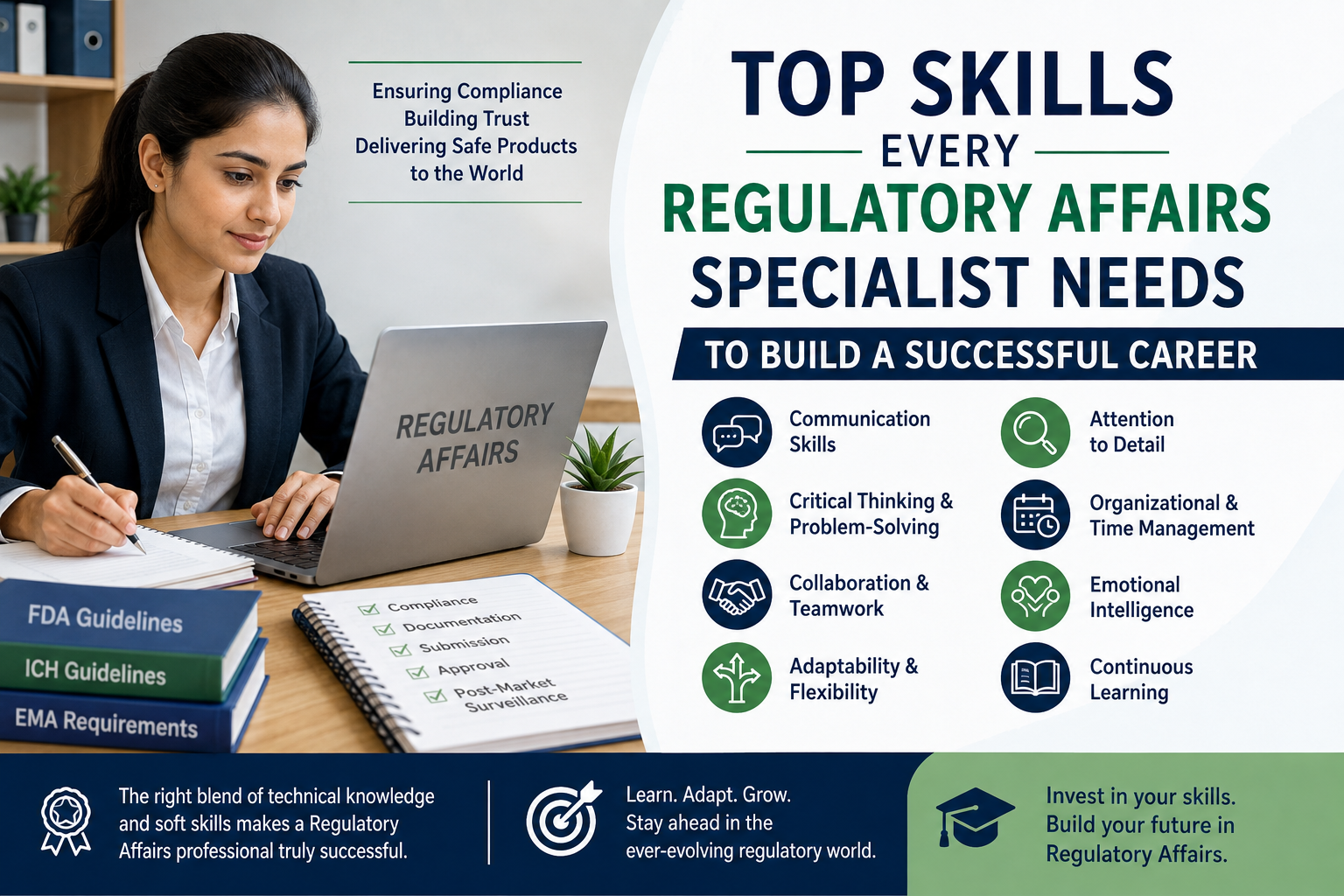
Let’s look at the most important skills every Regulatory Affairs Specialist should develop.
1. Communication Skills
Good communication is one of the most important skills in Regulatory Affairs.
A Regulatory Affairs Specialist often works as a bridge between different teams. You may be working with R&D, Quality Assurance, Clinical Research, Manufacturing, Medical Writing, Marketing, or Legal teams—all of whom may have different priorities and levels of regulatory knowledge.
Your job is often to take a complex regulatory requirement and explain it in a way that everyone can understand.
For example, instead of simply saying that a particular requirement comes from an FDA or ICH guideline, you may need to explain:
- What the requirement means
- Why it matters
- What documents are required
- Which team needs to provide the information
- What could happen if the requirement is missed
This requires clear and practical communication.
Written communication matters too
Regulatory professionals spend a significant amount of time dealing with documentation. This makes strong written communication particularly important.
Whether you are preparing regulatory documents, reviewing submissions, responding to regulatory questions, or documenting compliance activities, your writing needs to be:
- Clear
- Accurate
- Professional
- Consistent
- Easy to understand
Don’t forget listening
Communication isn’t only about speaking and writing.
Listening is equally important.
When working with cross-functional teams, you need to understand their concerns before recommending a regulatory approach. Good listening can help identify potential issues early and prevent misunderstandings later.
For a Regulatory Affairs professional, strong communication ultimately helps improve regulatory compliance, stakeholder coordination, documentation quality, and teamwork.
2. Critical Thinking and Problem-Solving
Regulatory Affairs rarely comes with a simple checklist where every situation has an obvious answer.
Regulations can be complex, requirements can vary between markets, and situations can arise where teams need to make decisions quickly.
This is where critical thinking and problem-solving skills become extremely valuable.
A Regulatory Affairs Specialist may need to review a regulatory requirement, identify a gap in existing documentation, understand the potential risk, and then work with the relevant team to find a practical solution.
For example, imagine a submission is being prepared and an important piece of information does not meet the expected regulatory requirement.
A good regulatory professional doesn’t simply say:
“This is not compliant.”
They should also be able to ask:
- What exactly is missing?
- Why is it required?
- What is the regulatory risk?
- What information is available?
- What options do we have?
- What would be the most appropriate compliant approach?
This ability to analyze a situation and find a practical solution is an important part of regulatory problem-solving.
Think beyond today’s requirement
Regulatory Affairs professionals also need to keep an eye on what is changing.
Regulatory expectations can evolve across regions such as the US, EU, and Asia. New guidance, digital health developments, post-market surveillance expectations, and changes in regulatory processes can all affect how companies operate.
Developing regulatory intelligence and strategic thinking can help professionals anticipate changes rather than simply reacting to them.
3. Collaboration and Teamwork
Regulatory Affairs is rarely a one-person job.
A successful submission or compliance activity usually requires information from multiple departments.
A Regulatory Affairs Specialist may coordinate with:
- Research & Development
- Quality Assurance
- Quality Control
- Manufacturing
- Clinical Research
- Medical Writing
- Pharmacovigilance
- Marketing
- Legal
- Supply Chain
Each department brings a different perspective to the project.
The Regulatory Affairs professional needs to bring these perspectives together while ensuring that regulatory requirements remain a priority.
Why teamwork matters
Suppose R&D is developing a product, Quality is reviewing compliance requirements, and Marketing is preparing product claims.
The Regulatory Affairs team may need to make sure that all three areas remain aligned with applicable regulatory expectations.
This requires cooperation—not just regulatory knowledge.
Building relationships with regulatory authorities
Regulatory professionals may also communicate with regulatory agencies such as the FDA, EMA, or MHRA, depending on their organization’s markets and responsibilities.
Professional, respectful, and well-prepared communication with regulatory authorities can help organizations respond effectively to questions and regulatory requirements.
Strong collaboration skills therefore help Regulatory Affairs Specialists become trusted partners within their organizations.
4. Adaptability and Flexibility
One thing you can be certain about in Regulatory Affairs is that change is constant.
Regulatory authorities regularly update guidelines, expectations, documentation requirements, and submission processes.
A professional who learned a regulatory process several years ago cannot simply assume that the same approach will always remain appropriate.
That’s why adaptability is such an important skill.
A good Regulatory Affairs Specialist should develop the habit of:
- Monitoring regulatory updates
- Reading new guidance documents
- Following industry developments
- Attending relevant webinars
- Participating in professional training
- Learning about changing submission requirements
- Keeping up with regulatory trends
For example, changes in electronic submission requirements or labeling expectations may require organizations to update their internal processes.
Professionals who are willing to learn and adapt can respond more effectively to these changes.
Be open to different perspectives
Adaptability also applies to teamwork.
Regulatory professionals work with people from scientific, technical, commercial, legal, and operational backgrounds. These individuals may not always agree on the best approach.
Being open to different viewpoints can help you understand the bigger picture and find solutions that balance regulatory compliance with business and development objectives.
5. Attention to Detail
If there is one skill that almost every Regulatory Affairs professional needs, it is attention to detail.
Regulatory work involves a large amount of documentation, data, and information. Even a small mistake can create unnecessary questions, delays, or compliance concerns.
Think about a regulatory submission containing hundreds or thousands of pages of information.
A missing document, inconsistent data point, incorrect reference, formatting issue, or labeling error can create problems that may take considerable time to resolve.
That’s why Regulatory Affairs Specialists need to develop the habit of checking their work carefully.
What does attention to detail look like in Regulatory Affairs?
It may involve:
- Checking documents for completeness
- Reviewing data consistency
- Verifying references
- Checking labeling information
- Reviewing regulatory submissions
- Ensuring correct formatting
- Identifying inconsistencies
- Confirming that documents meet applicable requirements
Regulatory professionals should not simply read documents—they should review them critically.
Good attention to detail improves submission quality, supports compliance, reduces errors, and helps build trust with internal stakeholders and regulatory authorities.
For someone starting a Regulatory Affairs career, developing this habit early can be extremely valuable.
6. Organizational and Time Management Skills
Regulatory Affairs can involve multiple projects, submissions, documents, and deadlines at the same time.
Imagine having to:
- Track regulatory submissions
- Follow up with different departments
- Review documents
- Respond to regulatory questions
- Monitor changing requirements
- Prepare reports
- Meet submission deadlines
Trying to manage everything without proper organization can quickly become overwhelming.
That’s why time management and organizational skills are essential.
A good Regulatory Affairs Specialist knows how to prioritize tasks based on:
- Regulatory deadlines
- Business priorities
- Submission timelines
- Risk
- Dependencies between teams
- Urgency of regulatory requests
Use tools to stay organized
Depending on the organization, professionals may use:
- Microsoft Excel
- Project management software
- Regulatory Information Management Systems (RIMS)
- Document management systems
- Submission tracking tools
- Task management platforms
The specific tool is less important than the ability to maintain a clear view of what needs to be done, who is responsible, and when it needs to be completed.
Strong organization reduces last-minute pressure and helps prevent avoidable mistakes.
7. Emotional Intelligence
Emotional intelligence may not be the first skill that comes to mind when you think about Regulatory Affairs.
However, it can have a major impact on how effectively you work with others.
Regulatory professionals often work under pressure. Submission deadlines can be tight, regulatory questions can be unexpected, and cross-functional teams may have competing priorities.
In these situations, knowing how to manage your own emotions—and understand the concerns of others—can make teamwork much easier.
Empathy matters
Imagine that another team is struggling to provide information because they are already managing several urgent activities.
Instead of simply demanding the information immediately, an emotionally intelligent professional tries to understand the situation and find a practical way forward.
This doesn’t mean compromising on regulatory deadlines.
It means communicating professionally, understanding other people’s challenges, and finding solutions without unnecessarily creating conflict.
Self-awareness is equally important
Regulatory Affairs can be stressful.
Professionals may have to deal with:
- Tight deadlines
- Regulatory questions
- Submission issues
- Audits
- Changing priorities
- High workloads
Self-awareness helps professionals recognize when they are under pressure and manage their reactions appropriately.
Being able to accept feedback, learn from mistakes, and remain professional during challenging situations is an important part of long-term career growth.
8. Continuous Learning
Although the original focus of Regulatory Affairs is often on regulations and documentation, one additional skill ties everything together: the willingness to keep learning.
Regulatory requirements don’t remain unchanged.
As you progress through your career, you may work with different products, markets, regulatory agencies, submission types, and compliance requirements.
A successful Regulatory Affairs professional therefore develops a habit of continuous learning.
You can build your knowledge through:
- Regulatory affairs courses
- Industry webinars
- Workshops
- Professional conferences
- Regulatory authority updates
- Industry publications
- Practical projects
- Mentorship
- Professional networking
For freshers, structured Regulatory Affairs training can also help bridge the gap between academic knowledge and industry expectations.
The goal isn’t to memorize every regulation.
It’s to develop the ability to understand requirements, find reliable information, ask the right questions, and apply regulatory knowledge correctly.
How Can Freshers Develop These Regulatory Affairs Skills?
If you are a fresher, you may be wondering:
“I don’t have work experience yet. How can I demonstrate these skills?”
You can start building them through practical learning.
For example:
Communication
Practice explaining a regulatory topic in simple language.
Critical Thinking
Take a regulatory scenario and identify possible compliance risks and solutions.
Attention to Detail
Practice reviewing sample regulatory documents for inconsistencies or missing information.
Teamwork
Participate in group projects, presentations, or industry training activities.
Organization
Practice creating submission trackers, document checklists, or project timelines.
Adaptability
Follow regulatory updates and learn how requirements differ between markets.
Emotional Intelligence
Learn to accept feedback and communicate professionally during disagreements.
These small activities can help you build the habits that become valuable in a professional Regulatory Affairs environment.
Why These Skills Matter for Regulatory Affairs Career Growth
Technical regulatory knowledge may help you get your first opportunity.
But your ability to communicate, solve problems, collaborate, manage priorities, and adapt to change can have a major impact on how far you progress.
As professionals gain experience, they may move into roles involving:
- Regulatory strategy
- Global regulatory submissions
- Regulatory intelligence
- Regulatory project management
- Product registration
- Compliance management
- Regulatory consulting
- Team leadership
At these levels, technical knowledge remains important—but leadership, communication, decision-making, and stakeholder management become increasingly valuable.
In other words, developing soft skills early can help you prepare not just for your first Regulatory Affairs job, but for long-term career growth.
Final Thoughts
A successful Regulatory Affairs Specialist is much more than someone who knows regulations.
The strongest professionals combine regulatory knowledge with communication, critical thinking, attention to detail, teamwork, adaptability, organization, and emotional intelligence.
These skills help professionals handle the day-to-day realities of regulatory work—from reviewing documents and managing deadlines to working with cross-functional teams and responding to changing regulatory expectations.
If you’re a fresher, don’t feel that you need to master everything immediately. Start with the fundamentals, practice your skills, seek feedback, and keep learning.
Your technical knowledge can help you understand the regulatory environment. Your soft skills can help you work effectively within it.
And together, they can give you a stronger foundation for building a successful career in Regulatory Affairs.
Start Building Your Regulatory Affairs Career
Looking to develop practical knowledge and prepare yourself for opportunities in Regulatory Affairs?
Skillbee Solution offers training designed to help learners build industry-relevant knowledge and understand the practical side of pharmaceutical Regulatory Affairs.