A regulatory submission can contain hundreds, sometimes thousands, of pages.
But the regulator does not want a pile of documents.
They want a submission that can be opened, understood, navigated, checked, and reviewed without unnecessary confusion.
That is one of the main reasons the electronic Common Technical Document (eCTD) has become such an important part of pharmaceutical regulatory submissions.
For regulatory teams, eCTD is not simply about converting documents into PDF files. It is about putting the right information in the right place, following the applicable technical requirements, and maintaining the submission properly throughout the product lifecycle.
And this is where many teams discover that a submission that looks complete internally may still have technical problems.
So, what exactly is eCTD?
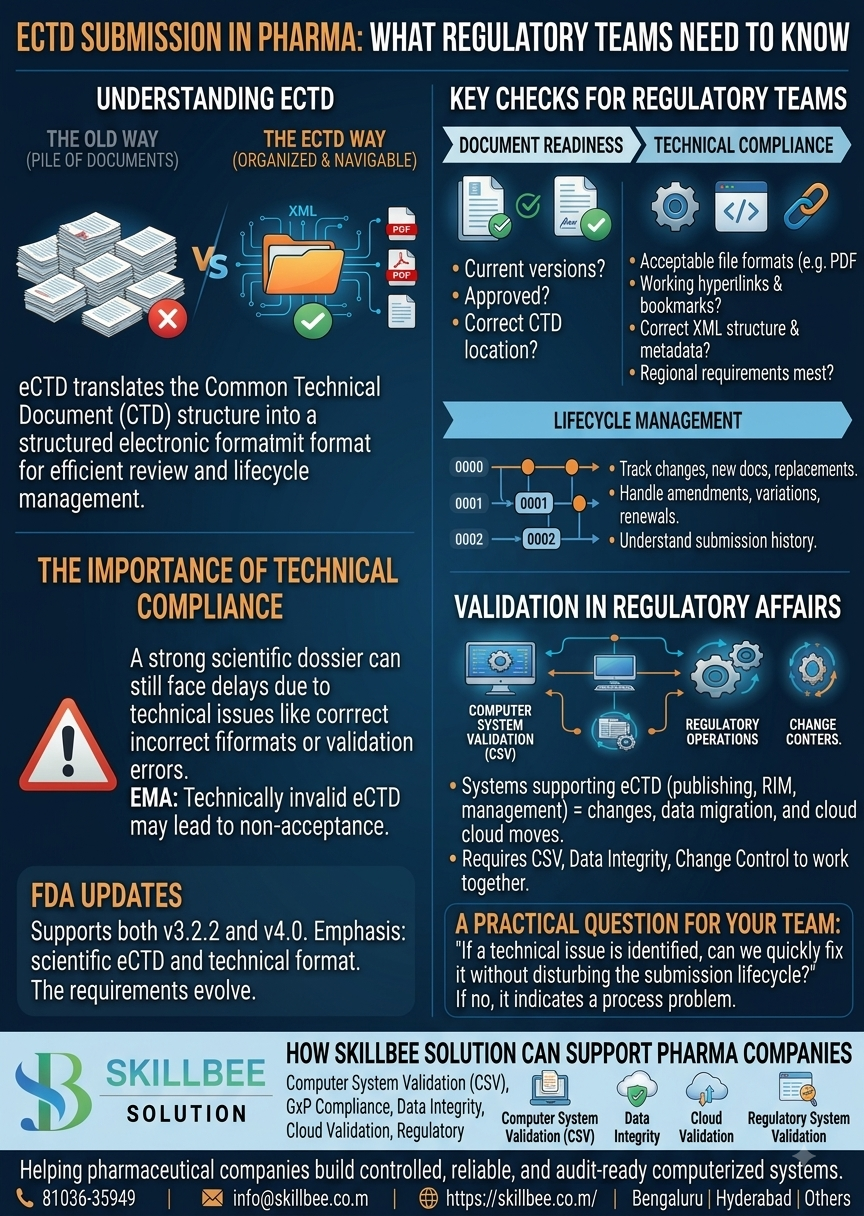
The Common Technical Document (CTD) provides a common structure for regulatory information submitted to health authorities.
eCTD takes that structure into an electronic format.
Documents are organised within the CTD modules and connected through an XML backbone, allowing reviewers to navigate the submission and its lifecycle more efficiently. EMA describes eCTD as the electronic implementation of the CTD, with documents arranged within the required directory structure.
For a regulatory team, this means the submission is not just about the content of individual documents.
The structure matters too.
A submission can be scientifically strong and still have a problem
This is something regulatory teams should keep in mind.
Imagine the clinical information is correct.
The quality documents are complete.
The safety information has been reviewed.
But the submission contains an incorrect file format, broken hyperlinks, an incorrect document location, missing technical information, or another validation issue.
The scientific content may be perfectly good.
Yet the submission can still face technical questions or delays.
EMA states that it performs technical validation before an application proceeds, and a technically invalid eCTD submission may result in non-acceptance and delay the start of the procedure.
That makes eCTD technical compliance an important part of submission readiness.
What should a regulatory team check?
Instead of waiting until the final submission day, teams should look at the dossier as a lifecycle.
Start with the documents.
Are they current?
Are they approved?
Are they in the correct CTD location?
Then look at the technical side.
Are the file formats acceptable?
Are links working?
Is the XML structure correct?
Are metadata and lifecycle attributes properly maintained?
Does the sequence follow the applicable regional requirements?
And finally, look at the submission as a whole.
Can another person open it and understand the history of the application without having to ask the original author?
That last question is often overlooked.
eCTD is also about lifecycle management
A pharmaceutical submission does not end when the initial application is sent.
There may be amendments, responses, variations, supplements, safety-related updates, renewals and other regulatory activities.
The submission therefore develops over time.
This is where proper lifecycle management becomes important.
A regulatory team needs to know what changed, which documents are new, which documents replace previous versions, and how the submission sequence should be handled.
FDA currently supports both eCTD v3.2.2 and eCTD v4.0, according to its current standards. FDA has accepted new regulatory applications in eCTD v4.0 since September 16, 2024, and its eCTD v4.0 standards were updated again in July 2026.
So teams should not rely on an old checklist and assume that the requirements will remain unchanged.
Where does validation come into the picture?
This is an area where Drug Regulatory Affairs and Computer System Validation increasingly meet.
Regulatory teams may work with submission management platforms, document management systems, publishing tools, regulatory information management systems and other computerized applications.
If these systems support GxP or regulated activities, companies need to consider whether they are appropriately controlled and validated for their intended use.
For example, if a company changes a regulatory submission system, migrates regulatory data, introduces a new publishing tool, or moves a regulatory platform to the cloud, the technology change should not be treated as purely an IT activity.
The regulatory process may depend on it.
That is why CSV, data integrity, change control and regulatory operations need to work together.
One practical question worth asking
Before your next eCTD submission, ask your team:
“If the regulator identifies a technical issue tomorrow, can we quickly find out what went wrong and correct it without disturbing the rest of the submission lifecycle?”
If the answer is no, the problem may not be the submission itself.
It may be the process behind it.
How SkillBee Solution can support pharma companies
At SkillBee Solution, we help pharmaceutical organisations strengthen the computerized systems and processes that support regulated operations.
Our services include Computer System Validation (CSV), validation of regulatory and GxP computerized systems, risk assessment, data integrity assessment, validation documentation, cloud system validation, testing support and audit readiness.
For companies operating in Bengaluru, Hyderabad and other locations, our focus is simple: help teams keep their regulated systems controlled, documented and ready for inspection.
Because a successful regulatory submission is not only about having the right information.
It is also about having the right structure, the right controls and the right evidence behind it.
SkillBee Solution
Computer System Validation | GxP Compliance | Data Integrity | Cloud Validation | Regulatory System Validation
 81036-35949
 info@skillbee.co.in
 https://skillbee.co.in/
Helping pharmaceutical companies build controlled, reliable and audit-ready computerized systems.