Introduction
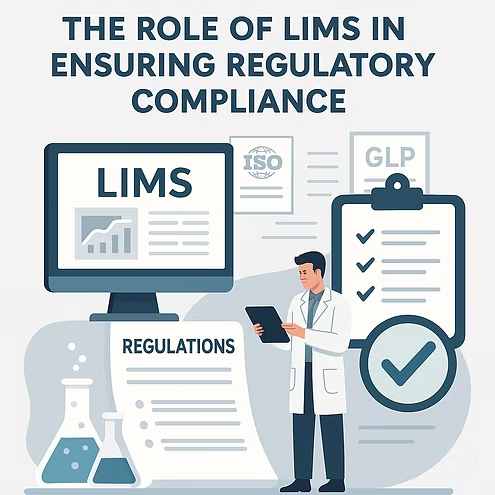
In today’s highly regulated laboratory environment, maintaining regulatory compliance is essential for ensuring data accuracy, operational integrity, and public trust. Laboratories operating in industries such as pharmaceuticals, biotechnology, clinical diagnostics, food safety, and environmental testing must comply with stringent regulations and standards. A Laboratory Information Management System (LIMS) plays a critical role in helping laboratories meet these regulatory demands while improving efficiency, traceability, and data integrity.
Understanding LIMS and Its Compliance Significance
A Laboratory Information Management System (LIMS) is a digital platform designed to manage laboratory data, workflows, samples, and processes throughout the entire testing lifecycle. By automating sample tracking, data capture, reporting, and inventory management, LIMS significantly reduces manual errors and enhances productivity.
Beyond operational efficiency, LIMS is a cornerstone of regulatory compliance. Regulations such as Good Laboratory Practice (GLP), Good Manufacturing Practice (GMP), FDA 21 CFR Part 11, CLIA, and ISO/IEC 17025 require laboratories to maintain accurate documentation, secure data handling, traceability, and audit readiness. LIMS supports these requirements through built-in features such as audit trails, electronic signatures, role-based access controls, and standardized workflows. As a result, laboratories can demonstrate transparency, accountability, and consistency during inspections and audits.
Regulatory Compliance in Laboratories
Regulatory compliance refers to adherence to laws, guidelines, and quality standards that govern laboratory operations. These regulations ensure that laboratory results are reliable, reproducible, and legally defensible.
Key regulatory frameworks include:
- ISO/IEC 17025, which defines competency requirements for testing and calibration laboratories.
- CLIA, which governs the accuracy and reliability of clinical laboratory testing in the United States.
- FDA regulations, including GLP and 21 CFR Part 11, which ensure data integrity, electronic record security, and traceability in regulated industries.
Failure to comply with these regulations can result in severe consequences, including financial penalties, loss of accreditation, reputational damage, or even laboratory shutdowns. Therefore, maintaining compliance is not only a legal obligation but also a critical element of quality assurance and risk management.
How LIMS Supports Regulatory Compliance
Improved Data Management and Accuracy
LIMS centralizes laboratory data and automates data capture, reducing reliance on paper-based systems and manual entry. Each sample is assigned a unique identifier and tracked through every stage of analysis. Integration with laboratory instruments enables real-time data capture, minimizing transcription errors and improving turnaround times.
Built-in validation rules ensure that incomplete or invalid data cannot be entered, further supporting data accuracy and compliance.
Secure Record-Keeping and Audit Readiness
One of the most valuable compliance features of LIMS is its robust audit trail functionality. Every action—data creation, modification, or approval—is automatically recorded with timestamps and user identification. This ensures full traceability and accountability, which are essential during regulatory audits.
LIMS also supports secure data storage, version control, and electronic signatures, ensuring compliance with regulations such as FDA 21 CFR Part 11.
Streamlined Compliance Reporting
LIMS simplifies regulatory reporting by generating standardized, audit-ready reports aligned with regulatory requirements. Laboratories can easily produce quality control reports, deviation logs, sample histories, and compliance documentation for inspections. Automated alerts for out-of-specification results further enhance proactive compliance management.
Ensuring Data Integrity with LIMS
Data integrity is a fundamental requirement in regulated laboratories. Regulatory agencies emphasize that data must be accurate, complete, consistent, and protected from unauthorized changes.
LIMS enforces data integrity through:
- Role-based access controls to limit unauthorized data manipulation
- Mandatory fields and validation checks to prevent incomplete records
- Encrypted data storage and secure data transmission
- Immutable audit trails documenting all system activities
These features help laboratories maintain compliance, protect their reputation, and avoid costly regulatory violations.
Workflow Standardization and Training Management
Standardized workflows are essential for ensuring consistency, reproducibility, and regulatory alignment. LIMS enforces standardized procedures by automating task assignments, sample workflows, testing protocols, and instrument calibration schedules.
Additionally, LIMS supports personnel compliance by tracking training records, certifications, and competency requirements. Only qualified personnel are permitted to perform regulated tasks, and automated alerts ensure that training and certifications remain up to date.
By analyzing workflow data, LIMS also enables continuous process improvement and early identification of quality issues.
Benefits of LIMS for Compliance and Operational Efficiency
Implementing a LIMS delivers measurable benefits beyond regulatory compliance. Laboratories experience:
- Reduced manual errors and administrative workload
- Faster sample processing and improved turnaround times
- Enhanced audit readiness and inspection confidence
- Lower risk of non-compliance penalties and recalls
- Reduced operational costs through efficiency and automation
Real-world implementations consistently demonstrate improvements in data quality, audit outcomes, and cost savings, making LIMS a strategic investment rather than a purely technical solution.
Future Trends in LIMS and Regulatory Compliance
The future of LIMS is being shaped by emerging technologies such as artificial intelligence (AI), machine learning (ML), and cloud computing. Advanced LIMS platforms are evolving into intelligent systems capable of predictive analytics, anomaly detection, and proactive compliance monitoring.
AI-powered LIMS can identify data trends, detect potential compliance risks, optimize workflows, and automatically generate regulatory reports. Cloud-based LIMS solutions provide scalability, centralized data access, and real-time collaboration across multiple laboratory sites while supporting compliance with data protection regulations such as GDPR and HIPAA.
As regulatory requirements continue to evolve, these technologies will play an increasingly critical role in digital compliance strategies.
Conclusion
LIMS has become an indispensable tool for achieving and sustaining regulatory compliance in modern laboratories. By automating workflows, ensuring data integrity, standardizing procedures, and enabling audit readiness, LIMS supports compliance with FDA, CLIA, GLP, GMP, and ISO/IEC 17025 requirements.
As regulatory expectations grow more complex, laboratories must move beyond manual systems and legacy tools. Investing in a modern, compliant LIMS provides a future-ready foundation that enhances quality, reduces risk, and improves operational efficiency.
Ultimately, LIMS is not just a compliance solution—it is a strategic asset that enables long-term laboratory success, regulatory confidence, and scientific excellence.